


Why Companies Are Relocating to Plymouth and the Branding Opportunities They Can Tap

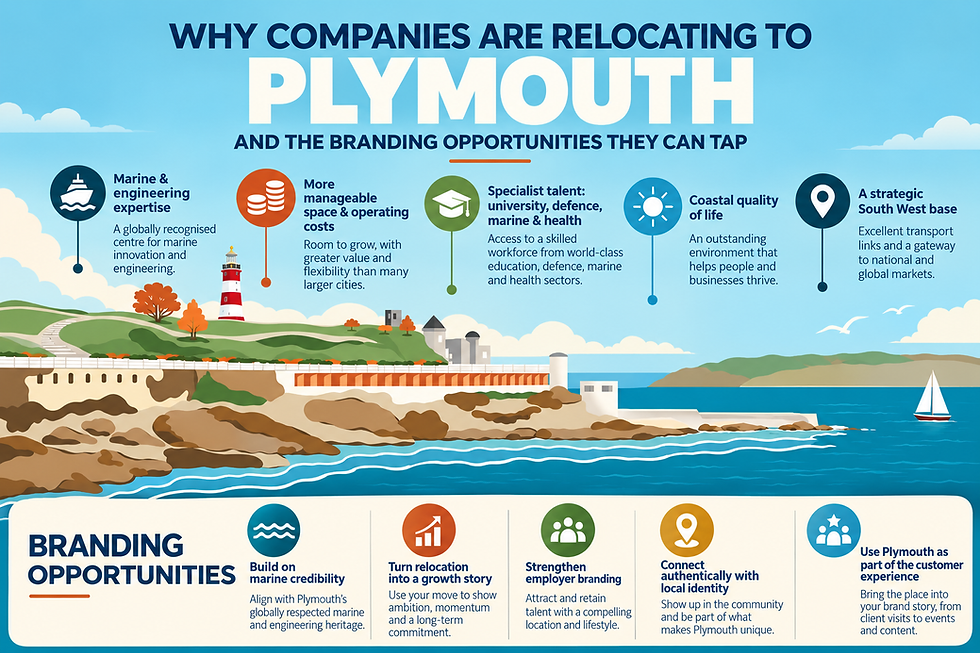
Why Companies Are Relocating to Plymouth
Plymouth is no longer just a place companies associate with naval history, ferry routes and summer tourism. It is becoming a serious relocation option for firms that want access to marine expertise, space to grow, lower operating pressure than larger cities, and a location with a clear identity.
For a business choosing where to move, the city offers a rare mix: a working port, a major naval base, university talent, science and health facilities, nearby industrial land, and a coastline that gives the place instant character. That combination is changing the types of companies looking at Plymouth, and it is creating strong opportunities for firms that want their move to mean more than a new postcode.

The companies moving to Plymouth are tied to place, talent and practical growth
The most natural fit for Plymouth is any business connected to the sea. Marine engineering, offshore energy, ocean science, defence suppliers, autonomous vessels, environmental monitoring and specialist manufacturing all have clear reasons to consider the city.
Plymouth has a long relationship with the Royal Navy and marine industry. That gives the area a depth of skills that is hard to copy. Firms that work with vessels, subsea equipment, sensors, composites, fabrication, maintenance or environmental research can gain proximity to people who understand the sector already.
The city is also attracting companies that need technical talent but do not need to be in London, Bristol or Manchester. These include:
Marine technology firms working on marine autonomy, clean propulsion, subsea systems and ocean data.
Defence and engineering suppliers serving naval, security and advanced manufacturing markets.
Life sciences and health-related companies that benefit from links to Derriford, research partners and clinical networks.
Creative and digital studios that want a lower-cost base with access to graduates and a strong lifestyle offer.
Professional services firms opening regional bases to serve Devon, Cornwall and the wider South West.
Logistics, trade and distribution businesses that need road access, port links and industrial space.
Food, drink and tourism-adjacent brands that can build a clear West Country or coastal story.
Plymouth is not the obvious choice for every company. It does not have the scale of a large financial centre, and it is not as connected by rail or air as some UK cities. But for the right type of business, the city gives more than cheap floorspace. It gives relevance.
A marine robotics company in Plymouth feels rooted in the right setting. A health technology company near Derriford feels close to the right expertise. A lifestyle brand built around the coast can make the city part of its story without forcing it.
That sense of fit matters. Places are part of how businesses are understood.
Why companies are coming to Plymouth now
Relocation decisions are rarely based on one reason. For Plymouth, several factors tend to work together.
Costs are more manageable than in larger cities
Many firms need room for labs, workshops, storage, testing, studios or production space. In major city centres, those costs can become a drag. Plymouth can offer a more manageable cost base, especially for companies that need physical space rather than just a small office.
That can help growing firms preserve cash, hire sooner, or invest in equipment. For companies in engineering, marine, manufacturing or research, space is often not optional. It is part of the product.
The talent pool is more specialised than outsiders expect
Plymouth has the University of Plymouth, strong marine research activity, engineering skills linked to the dockyard and defence sector, and health knowledge around Derriford. It also draws people from Devon and Cornwall who may prefer to build careers in the South West rather than move away.
The graduate pipeline matters, but so does the experienced workforce. Companies moving into Plymouth can find people with practical knowledge of harsh marine environments, naval requirements, applied engineering, environmental science and field testing.
The city has a strong quality-of-life pull
Recruitment is not only about wages. People want to live somewhere that offers space, coast, countryside and culture. Plymouth has an advantage here. Dartmoor is close. Cornwall is nearby. The waterfront is part of daily life rather than a weekend trip.
That lifestyle pull can help companies hire people who want a better balance without leaving technical or creative work behind. For some firms, Plymouth becomes part of the employee offer.
The South West needs stronger regional anchors
Many national businesses are rethinking where they place teams. Hybrid work has made regional bases more credible. Companies no longer need every function clustered in one expensive city.
Plymouth can serve Devon, Cornwall and parts of Somerset. It gives firms a South West base with a clear regional identity. For service businesses, that can be valuable. It signals commitment to the area rather than remote coverage from elsewhere.
Where relocating companies are choosing to base themselves
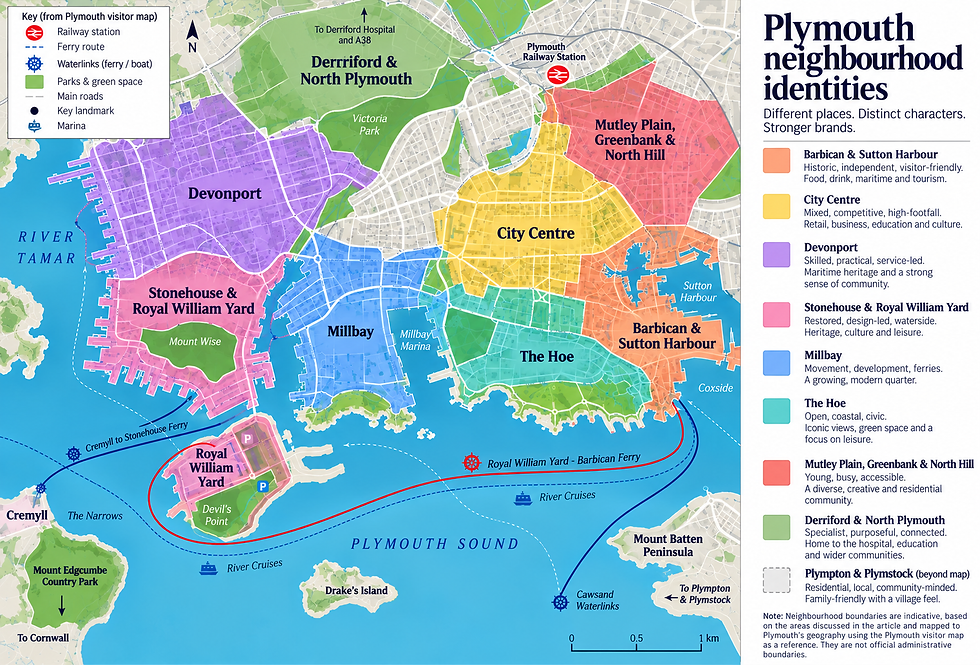
Plymouth does not have one single business district. The right location depends on the type of company, the need for space, and the role the city plays in the brand.
Area | Best fit | Why it works |
Devonport and Oceansgate | Marine, defence, engineering, advanced manufacturing | Close to dockyard activity, marine infrastructure and specialist suppliers |
Derriford and Plymouth Science Park | Health, science, technology, research-led firms | Near hospital, university links, research networks and workspace suited to knowledge firms |
City centre | Professional services, training, creative businesses, customer-facing firms | Good visibility, transport links, amenities and access to talent |
Sutton Harbour, Barbican and waterfront areas | Hospitality, leisure, marine services, lifestyle brands | Strong sense of place, visitor footfall and coastal identity |
Royal William Yard and Millbay | Creative, leisure, specialist services and experience-led businesses | Character buildings, waterside setting and strong public recognition |
Eastern and northern business parks | Trade, logistics, light industrial and production firms | Better road access, larger units and practical operating space |
Devonport and Oceansgate suit marine and defence firms
For companies tied to maritime work, this part of the city carries obvious weight. It places firms close to Plymouth’s naval and marine ecosystem and gives them a location that matches their technical focus.
A company working on vessel systems, fabrication, marine electronics or offshore support can use the area to show practical credibility. The location itself says, “We are close to the work.”
Derriford works for science, health and knowledge-led firms
Derriford is a good fit for businesses that need access to healthcare, research or specialist technical talent. Plymouth Science Park gives the area a business and research identity, while the hospital brings a clinical and life sciences dimension.
For a health technology company, medical device supplier, diagnostics firm or research-led start-up, this setting can support recruitment, partnerships and credibility.
The waterfront works for brands that benefit from place
Not every company needs a lab or workshop. Some need atmosphere, footfall or a strong public-facing presence. The Barbican, Sutton Harbour, Royal William Yard and Millbay all offer a sense of Plymouth that is easy for customers to understand.
These locations suit hospitality, leisure, specialist retail, marine tourism, events, design-led businesses and lifestyle brands. They can also suit small consultancies or studios that want to use the city’s character as part of their identity.
Business parks suit practical operators
Firms that need loading, parking, storage, trade counters or production space are more likely to look beyond the waterfront. Plymouth’s business parks and industrial areas give growing companies room to operate without forcing everything into a city centre setting.
That matters for suppliers, installers, local distribution firms, food production, construction-related businesses and manufacturers.
What companies need to know before relocating
A move to Plymouth can work well, but companies need to understand the city on practical terms before committing.
Transport links shape planning
Plymouth has rail and road links across the South West, but it is still a long way from some UK business centres. Companies with frequent national travel needs should plan around journey times and logistics. For goods-based firms, the A38 and connections towards Exeter, Cornwall and the wider region matter.
For some businesses, the distance is a drawback. For others, it becomes part of the appeal. It depends on whether the company needs daily access to major cities or closer access to South West customers, suppliers and natural testing environments.
Recruitment needs a local strategy
Plymouth has talent, but employers still need to work for it. Strong links with the university, colleges, local networks and sector groups can make a real difference. Companies moving from larger cities should not assume the same recruitment channels will work in the same way.
The best results often come when firms show a long-term commitment to the area. Local candidates respond to employers that seem serious about Plymouth, not just passing through.
The city has distinct audiences
Plymouth includes students, naval and dockyard communities, families, visitors, creatives, engineers, healthcare workers and coastal lifestyle seekers. A message that works for one group may not work for another.
A relocation brand should be clear about who it needs to reach:
Future employees
Local customers
Regional partners
Investors and funders
Suppliers
The wider community
Each group may care about a different part of the move.
Planning and property choices need care
Some of Plymouth’s most attractive areas include heritage buildings, waterside settings or mixed-use neighbourhoods. These can be powerful for identity, but they may come with limits around access, fit-out, deliveries or signage.
Industrial and science locations may be more practical, but less visible to the public. The right answer depends on whether the site is mainly for operations, recruitment, customer experience or reputation.
The branding opportunities for companies moving to Plymouth
A relocation is more than an address change. It is a chance to reframe the business. Plymouth gives companies several strong brand routes if they use them carefully.
Build around the city’s marine credibility
For marine, engineering and environmental firms, Plymouth offers immediate relevance. The city’s relationship with the sea is real, not decorative. That makes it a strong base for brand storytelling.
A company can connect its identity to:
Ocean testing and marine conditions
Naval and engineering heritage
Sustainability and marine protection
South West coastal expertise
Practical, hands-on problem solving
The key is to be specific. Generic sea imagery is easy to ignore. A stronger brand message might focus on testing equipment in demanding waters, hiring people with dockyard skills, or supporting cleaner marine systems.
Use the move to show confidence and growth
Relocation can signal progress. A company that moves to Plymouth can frame the decision around access to skills, space, research, customers or a better base for the next stage.
That message works well for press, recruitment, stakeholder updates and customer communications. It should answer the obvious question: why Plymouth?
A clear answer might be:
“We chose Plymouth because our work belongs close to the water, close to engineering talent, and close to the South West customers we serve.”
That kind of statement is simple, but useful. It gives people a reason to remember the move.
Make the employer brand stronger
Many companies underuse relocation as a recruitment story. Plymouth can support a strong employer message because the area offers both work and lifestyle benefits.
Rather than only promoting vacancies, businesses can show what the move means for staff:
More space for practical work
Access to marine or science partnerships
A coastal setting for people who value outdoor life
A chance to build careers in the South West
A workplace connected to a clear local purpose
This matters for graduate recruitment, experienced hires and people looking to return to the region.
Connect with local identity without pretending to be local overnight
New arrivals should be careful. Plymouth has a strong sense of place, and businesses that arrive with loud claims can sound false.
A better approach is respectful and specific. Mention what the company is learning, who it is partnering with, and how it plans to contribute. Local sponsorship, apprenticeships, school outreach, supplier relationships and visible community involvement can all support the brand over time.
The strongest local reputation comes from doing useful things consistently.
Use location as part of customer experience
For visitor-facing businesses, hospitality brands, marine tourism operators and lifestyle companies, Plymouth can become part of the product. The waterfront, history, food culture, ferry links and access to Devon and Cornwall all help shape how customers feel.
For B2B firms, the site can also matter. Inviting clients to a waterside location, a specialist workshop, a science park or a working marine area can make the business more tangible. The environment helps explain the company’s value.
Refresh visual identity with restraint
Companies relocating to Plymouth do not need to turn everything blue and add waves to the logo. Many do, and most of it looks the same.
Better branding draws from the area in more thoughtful ways:
Materials and textures from dockyards, stone, water, maps or engineering drawings
Photography that shows real work in real places
Language that is direct and practical
A colour palette that hints at coast and industry without copying every seaside cliché
Case studies tied to local projects, partnerships or conditions
The most credible brands avoid using Plymouth as a backdrop only. They show how the place affects the work.

What a successful Plymouth relocation story should include
A strong relocation message does not need to be long. It needs to be clear, grounded and believable.
The best stories usually include five parts:
Why the company moved
Space, talent, marine access, research links, regional growth or customer demand.
Why Plymouth fits
A connection to the company’s work, market or values.
Where the company is based
Enough detail to explain the choice without turning it into a property announcement.
What the move means for people
Jobs, partnerships, services, growth plans or improved delivery.
How the company will contribute
Local hiring, training, supply chain relationships, community support or sector activity.
A relocation to Plymouth should not feel like a press release written around a map pin. It should feel like a business decision with a clear purpose.
Plymouth is well placed for companies that need more than a generic city base. It suits firms with a link to marine industries, defence, science, health, engineering, creative work, logistics and regional service delivery. The companies that gain the most will be those that understand the city’s practical realities and treat its identity with care.
The opportunity is not only to relocate to Plymouth. It is to let Plymouth sharpen the story of what the company does, who it serves and why its next stage of growth belongs there.


Comments