


Plymouth Regeneration and Investment Opportunities How Brands Can Align with the City's Growth


Plymouth Regeneration and Investment Opportunities
Plymouth is entering a new phase of change, and this time the opportunity is not limited to developers, landlords or public bodies. For businesses, the city’s regeneration creates a practical question: how should a brand show up in a place that is actively reshaping itself?
Recent reporting has put Plymouth back in the spotlight. Savills has described the city as an emerging investment hotspot, while local coverage has highlighted a further £50 million boost for city improvements. Taken together, the message is clear. Plymouth is not standing still.
That matters for companies of all sizes. Regeneration changes streets, footfall, housing, visitor patterns, local pride and commercial expectations. Brands that understand this early can become part of the city’s next chapter rather than simply selling into it from the outside.
Why Plymouth is attracting fresh attention
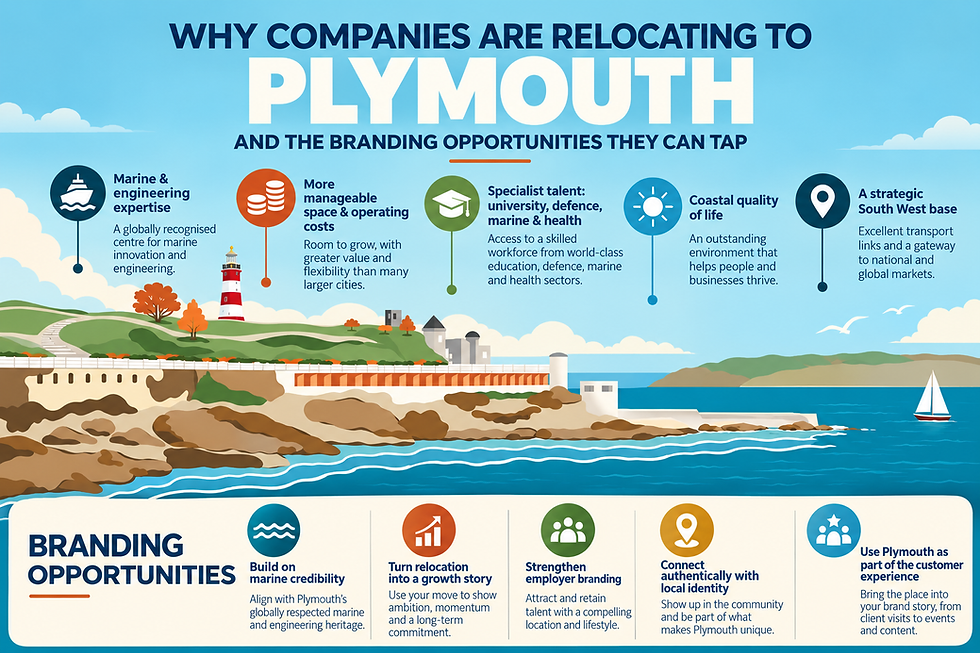
Plymouth has long had strong foundations. It has a major naval and defence presence, two universities, a significant student population, a working waterfront, a growing marine and advanced manufacturing sector, and one of the most recognisable coastal identities in the UK.
What is changing now is the level of focus on regeneration and investment.
The city has several qualities that investors often look for:
A waterfront setting with room for better public spaces
A relatively affordable property market compared with many southern cities
A strong public sector and defence base
A large student and graduate population
A growing interest in marine, ocean technology and clean growth
A city centre with clear scope for renewal
Savills’ view of Plymouth as an investment hotspot reflects a wider shift in how regional cities are being assessed. Investors are not only looking at places that are already expensive. They are also looking at cities where infrastructure, housing, public realm and local identity can improve together.
Plymouth fits that picture. It has heritage, coast, skills and space for change. The challenge is making regeneration feel joined up, visible and relevant to people who live, work and spend time in the city.
That is where brands have a role.
A new building or public space can help change perceptions, but businesses shape the everyday experience. Cafés, retailers, estate agents, hospitality venues, trades, service firms, developers, cultural organisations and local employers all influence how people feel about a place.
If the city is investing in itself, companies need branding that shows they are invested too.
The developments shaping Plymouth’s next chapter
Regeneration is rarely one single project. It is a collection of improvements that gradually change how a city works and how people talk about it. In Plymouth, several themes stand out.
The city centre is being rethought
Like many UK city centres, Plymouth has had to adapt to changes in retail, working patterns and visitor behaviour. The answer is not simply to fill empty units. The stronger opportunity is to create a centre that mixes shopping, leisure, housing, culture, food, green space and events.
Public realm investment can make a major difference here. Better streets, safer walking routes, improved lighting, planting, seating and more attractive gathering spaces can encourage people to spend longer in the city centre.
For brands, this means the city centre may become less about pure transactions and more about experience. A shopfront, café, showroom or local service brand will need to feel welcoming, useful and rooted in Plymouth’s changing identity.
The waterfront continues to drive value
Plymouth’s waterfront is one of its clearest advantages. Few cities can combine maritime heritage, working docks, leisure, tourism and coastal views in the same way.
Areas linked to the water, including Millbay, Sutton Harbour and wider waterfront locations, have long been central to the city’s regeneration story. Better connections between the waterfront and the city centre can help Plymouth feel more coherent to visitors, residents and investors.
Brands near the waterfront should pay close attention to place. Generic coastal styling is not enough. Plymouth’s maritime identity has depth, from naval connections to ocean science and local communities. Strong branding should reflect that richness without falling into clichés.
Growth sectors are giving the city a sharper economic story
Plymouth’s future is not only about property. The city has credible sector strengths, especially around marine industries, defence, manufacturing, health, education and environmental research.
The Plymouth and South Devon Freeport has also been positioned as a way to support investment in advanced manufacturing, marine innovation and clean growth. For companies in supply chains linked to these areas, the branding opportunity is significant.
A business that can clearly explain what it does, why it belongs in Plymouth and how it contributes to the region’s growth will be easier to trust. That matters when bidding for work, recruiting talent, building partnerships or approaching investors.
What the £50 million boost signals for businesses
The reported £50 million funding boost is important not only because of the amount, but because of what it signals. Public investment can help unlock confidence. When councils, institutions and funding bodies commit to visible improvements, private businesses often start to reassess their own plans.
That does not mean every business should rush into a rebrand. It does mean Plymouth-based and Plymouth-facing companies should ask sharper questions.
Does the brand still reflect where the city is heading?
Does it look credible next to new investment and improved public spaces?
Does the language feel local, current and clear?
Does the customer experience match the promise?
Does the business feel like part of Plymouth’s future, or part of an older version of the city?
Regeneration can create a gap between old perceptions and new reality. Some people outside Plymouth may still hold dated views of the city. Local people may also be sceptical if they have seen plans come and go. Brands can help close that gap by being specific, consistent and honest.
The smartest companies will avoid vague claims about growth. They will show evidence through their choices. That might mean improving signage, refreshing a tired website, using better photography, telling local stories, supporting community projects, hiring locally or creating spaces that feel genuinely welcoming.
Brand alignment is not decoration. It is proof of participation.
How companies can align their branding with Plymouth’s regeneration
A brand does not need to shout about regeneration to benefit from it. In many cases, the best approach is quieter and more grounded. The aim is to make the business feel relevant to the city Plymouth is becoming.
Start with a clear local position
Every business should be able to answer one simple question: why does this brand make sense in Plymouth now?
The answer will vary. A hospitality brand might focus on local produce and waterfront culture. A construction firm might highlight its role in improving homes and public spaces. A recruitment company might connect employers with emerging talent. A marine technology business might link its work to Plymouth’s ocean economy.
The key is specificity. “Proud to serve Plymouth” is fine, but it is not enough on its own. A stronger position gives people something more concrete to remember.
For example:
Supporting Plymouth’s growing marine and engineering sectors
Helping independent businesses make the most of a changing city centre
Creating better visitor experiences around the waterfront
Building homes and spaces that fit the city’s next stage
Connecting graduates with regional employers
This kind of clarity helps a brand speak with purpose.
Refresh visual identity without losing local trust
Regeneration often changes the visual standard of a place. New public spaces, improved shopfronts and better developments can make tired branding more noticeable.
That does not mean every company needs a dramatic new logo. Often, smaller improvements have more impact:
Clearer signage
Better colour contrast
More consistent typography
Stronger photography
A simpler website structure
Updated vehicle graphics
Printed materials that feel current
A more polished Google Business Profile
Local trust matters in Plymouth. Businesses with history should not erase it. A good brand refresh keeps the recognition people already value while making the company feel ready for future growth.
Use real Plymouth imagery
Stock images can make a local brand feel detached. Plymouth has enough visual character to avoid that. The Hoe, the Barbican, Royal William Yard, the waterfront, city centre streets, marinas, green spaces and neighbourhood centres can all help tell a more authentic story.
The best images do not need to be obvious postcards. A well-composed image of a workshop, a local street, a harbour detail or a community space can say more than a generic skyline.
This is especially useful for companies trying to build trust with local customers. Real imagery sends a simple message: we are here, and we understand this place.

Make the customer journey match the city’s ambitions
Branding is more than visuals. It is the full experience people have with a business.
If Plymouth’s public spaces improve, customers may expect better experiences from the businesses around them. That applies online and offline.
A company can strengthen its brand by improving basic touchpoints:
Clear opening hours and location information
Fast responses to enquiries
Easy booking or purchasing
Friendly, consistent tone of voice
Accessible signage and web content
Clean, cared-for premises
Simple explanations of services and prices
These details shape perception. A polished logo cannot compensate for a confusing customer experience.
Tell stories of contribution, not self-praise
Businesses often want to be seen as part of regeneration, but there is a risk of sounding opportunistic. The better route is to show contribution.
That might include:
Training apprentices
Restoring a local building
Using local suppliers
Supporting events
Improving a shopfront
Creating jobs
Reducing waste
Helping people access services
Sponsoring grassroots sport or culture
Stories like these work because they are tangible. They show how a company fits into the wider city.
The tone matters. Plymouth has a strong local identity and people can spot empty claims. Keep the language plain. Give details. Let the work speak.
What different sectors should focus on
The regeneration story will affect sectors in different ways. A strong brand strategy should reflect the type of business and how people interact with it.
Sector | Branding focus | Practical move |
Property and development | Trust, quality and local fit | Use clear project messaging, local photography and plain explanations of community benefit |
Hospitality and leisure | Experience and place | Connect menus, interiors and service style to Plymouth’s coastal character |
Retail | Discoverability and loyalty | Improve shopfronts, local search visibility and in-store storytelling |
Marine and manufacturing | Credibility and skills | Explain capabilities clearly and show links to Plymouth’s sector strengths |
Professional services | Confidence and accessibility | Replace generic messaging with specific local knowledge and useful guidance |
Culture and tourism | Distinctiveness and memory | Build campaigns around real Plymouth stories, not generic seaside themes |
This is where Plymouth regeneration and investment opportunities become more than a planning topic. They become a brand planning topic.
A company that understands its place in the city can make better decisions about name, message, design, content, customer service and local partnerships.
Common branding mistakes to avoid during regeneration
Regeneration can create pressure to act quickly. That pressure can lead to poor choices.
One common mistake is copying the look of new developments. Clean lines, muted colours and modern type can work, but if every brand follows the same style, the city becomes bland. Plymouth’s strength lies partly in its mix of heritage, coast, industry, education and independent culture.
Another mistake is overusing civic language. Words such as “future”, “growth” and “community” only work when backed by detail. Without proof, they feel thin.
Businesses should also avoid treating regeneration as a finished project. City change takes time. There will be disruption, debate and delays as well as progress. Brands need a message that can handle that reality.
A grounded approach works best:
Be optimistic, but not glossy
Be local, but not narrow
Be modern, but not anonymous
Be proud, but not boastful
Be clear, not complicated
The most trusted brands will be those that combine ambition with usefulness.
How to prepare your brand for Plymouth’s next phase
A practical brand review does not need to be slow or expensive. Start with the areas that most affect perception.
Review the first impression. Search for the business online, walk past the premises, look at the signage, read the homepage and check recent photos. Ask whether the brand feels credible in a city attracting new attention.
Then review the message. The business should be able to explain who it helps, what it does and why it matters in Plymouth. If that takes too long, the message needs work.
Next, review consistency. A brand that looks one way on a website, another way on signage and another way on social channels feels less trustworthy. Consistency makes a company easier to recognise and remember.
Finally, review local relevance. Look for ways to connect the brand to Plymouth without forcing it. That may be through imagery, partnerships, recruitment, stories, materials, events or service design.
The companies that benefit most from regeneration will not simply wait for more footfall or higher confidence. They will prepare for it.
Plymouth’s growth story is still being written. New funding, new development and renewed investor interest can help change the city’s prospects, but the everyday experience will be shaped by the businesses that occupy its streets, serve its communities and tell its stories.
For brands, the opportunity is clear: understand the direction of travel, improve the way you present yourself, and make a visible contribution to the city around you. Regeneration is not only something happening to Plymouth. For the right companies, it is something to be part of.


Comments